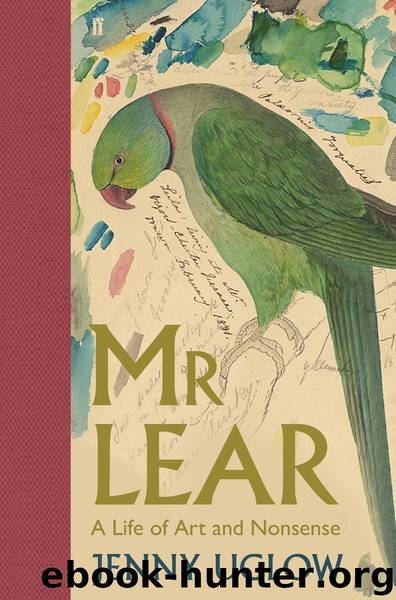
Mr Lear by Jenny Uglow
Author:Jenny Uglow [Jenny Uglow]
Language: eng
Format: epub
ISBN: 9780571336586
Publisher: Faber & Faber
Published: 2017-11-11T05:00:00+00:00
He sailed on the night of 4 April, looking back at Corfu under a bright full moon. Giorgio joined him in Paxos and for the next eight weeks they travelled the islands.
In each island Lear contacted the British Resident ministers, taking advantage of clean rooms, good meals and talk and books. He was welcomed everywhere and sketched every day, even Sundays, although the kindly Scottish Baron d’Everton on Santa Maura ‘was awfully Sabbatical, & don’t quite approve my sketching tomorrow evidently’.
He had strong opinions on what he found. Paxos was quiet and provincial. Santa Maura, despite the sea of olives spreading out like a morning view by Claude or Turner, was ‘hideously dry’, inland ‘withered wrinkled, chasmy, rocky valley – gullies’. Initially Lear thought this island beautiful, but in the blazing heat he took against it, fearing fever around its lagoons and salt-pans. The next island, Ithaca, was grand and full of poetic resonance. Cerigo – the ancient Cythera – was gold with ripening corn; Zante was dazzling and elegant, but its people too violent; Cephalonia was beautiful but sombre, dominated by its Black Mountain. Everywhere he went he hunted for views to sketch, walking through shrublands of myrtle, arbutus and holm-oak, jotting reminders in his diary: ‘Great naked slabs of rock. Twisted olives. Asphodels & lambs.’ Once, when someone suggested going with him, Giorgio explained: ‘My master is like one hunting dog – he looks there & here, & does not go straight, – he is always looking about as he goes, & cannot attend to anything: – so you would only be like one log of wood – & bother would be good for nothing.’
On Santa Maura he strode out to the rocky Cape Ducato, where Sappho leapt to her death, inspired by the dark grey cliffs, edged with foam, with vultures on a ridge and shards of pottery scattered round the ruined temples. At Metaxata, on Cephalonia, he searched for traces of a modern, not an ancient, poet:
Lord Byron’s house was easily found – the small children knowing it. Every one I met said – ‘Yes – we know it, ἀλλὰ θέλεις ἀγωράσει Μέρλαις;’ [But would you like to buy some laces?] – to G.’s amusement. And at the house itself, (I was there in 1848 –) was nil save the white barrel earthen broken-handled jug – still there as then. —
Download
This site does not store any files on its server. We only index and link to content provided by other sites. Please contact the content providers to delete copyright contents if any and email us, we'll remove relevant links or contents immediately.
Cecilia; Or, Memoirs of an Heiress — Volume 2 by Fanny Burney(32109)
Cecilia; Or, Memoirs of an Heiress — Volume 3 by Fanny Burney(32090)
Fanny Burney by Claire Harman(26750)
We're Going to Need More Wine by Gabrielle Union(19230)
Plagued by Fire by Paul Hendrickson(17557)
All the Missing Girls by Megan Miranda(16825)
Cat's cradle by Kurt Vonnegut(15586)
For the Love of Europe by Rick Steves(14997)
Bombshells: Glamour Girls of a Lifetime by Sullivan Steve(14241)
Leonardo da Vinci by Walter Isaacson(13545)
4 3 2 1: A Novel by Paul Auster(12641)
The remains of the day by Kazuo Ishiguro(9247)
Adultolescence by Gabbie Hanna(9032)
Note to Self by Connor Franta(7762)
Diary of a Player by Brad Paisley(7745)
Giovanni's Room by James Baldwin(7601)
What Does This Button Do? by Bruce Dickinson(6325)
Ego Is the Enemy by Ryan Holiday(5660)
Born a Crime by Trevor Noah(5505)
